1. Custom foam: the first level of personalisation
Foam is the starting point of any customisation. Cut to the exact shape of each piece of equipment, it holds your gear firmly in place and absorbs shocks during transport. Each cavity is made to measure, taking into account the dimensions, weight and fragility of the item it protects.
Beyond protection, foam offers an immediate practical advantage: when you open the flight case, you can see at a glance whether any item is missing before closing the case. Density and thickness are tailored to each project.
2. Dividers: organise and protect the interior
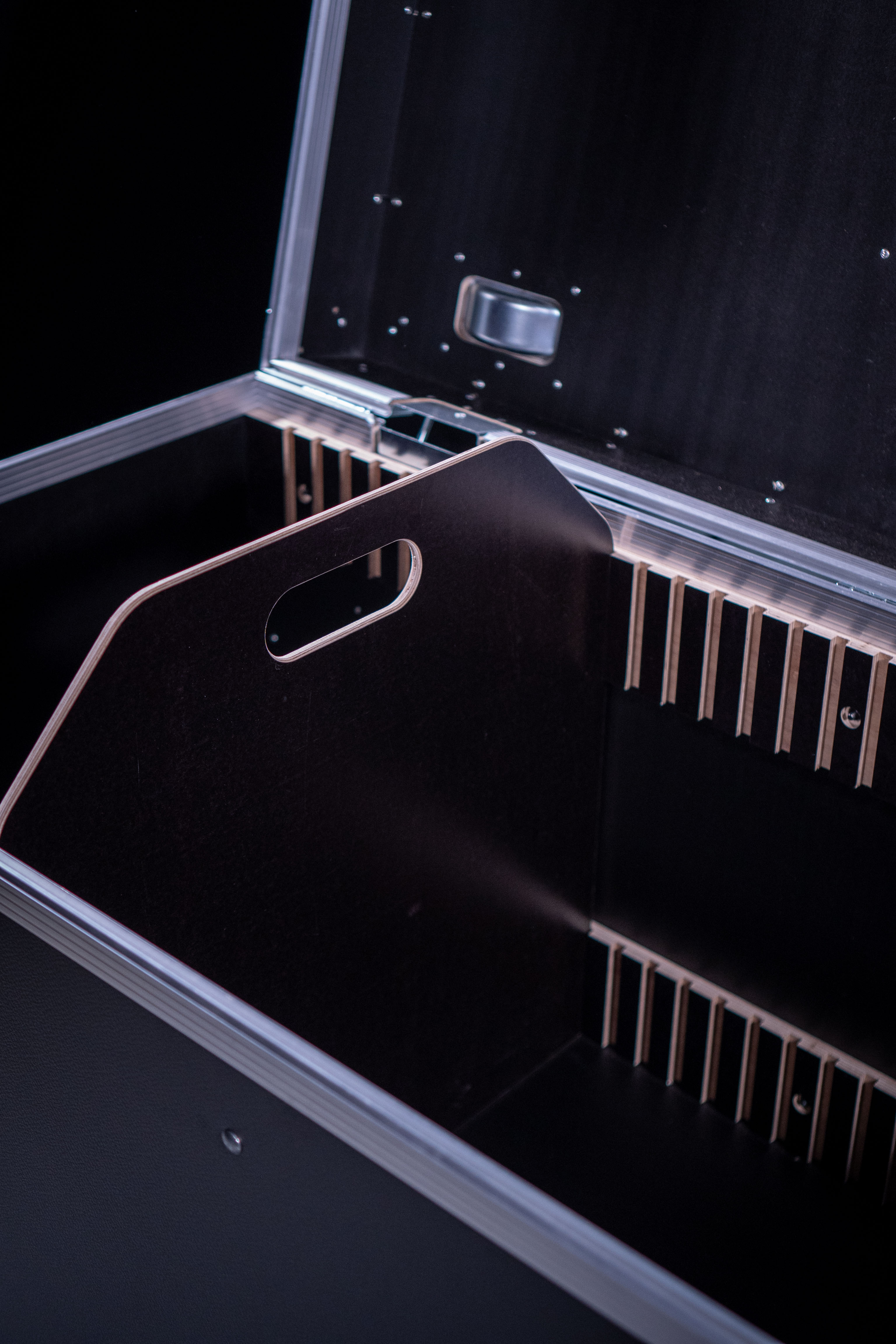
When a flight case holds several items, the main risk is contact between them. Dividers partition the interior space and prevent any movement between pieces of equipment. Removable, they offer real flexibility: you can reorganise the interior from one job to the next without changing the case.
They are especially useful for multi-equipment trunks: cables and accessories kept separate from fragile devices, small parts grouped in a dedicated compartment.
3. Automatic castors: stack without constraints
For fleets of flight cases that are regularly stacked, automatic castors are a game changer. Unlike standard castors that stay in whatever position they were left in, automatic castors realign themselves along the case's axis when lifted.
The result: each case can be placed on top of another without having to reposition the castors one by one. Stacking is faster, more stable, and the risk of toppling is reduced. It saves real time during loading and unloading, especially when crews handle dozens of cases per day.
4. Engraving: identify your equipment at a glance
On set, in a warehouse or in a truck loaded with cases, you need to quickly identify who a flight case belongs to and what it contains. Engraving allows you to mark the panel directly with your company name, a logo, an inventory number or a description of the contents.
Unlike a sticker that peels off or a marker that fades, engraving is permanent and withstands friction, weather and repeated handling. It is also an effective proof of ownership in case of lending, rental or third-party transport.
5. Electrical fittings and LED: a plug-and-play flight case
Some uses require the equipment to operate directly inside its flight case, without being removed. This applies to control desks, technical racks and mobile demonstration stations.
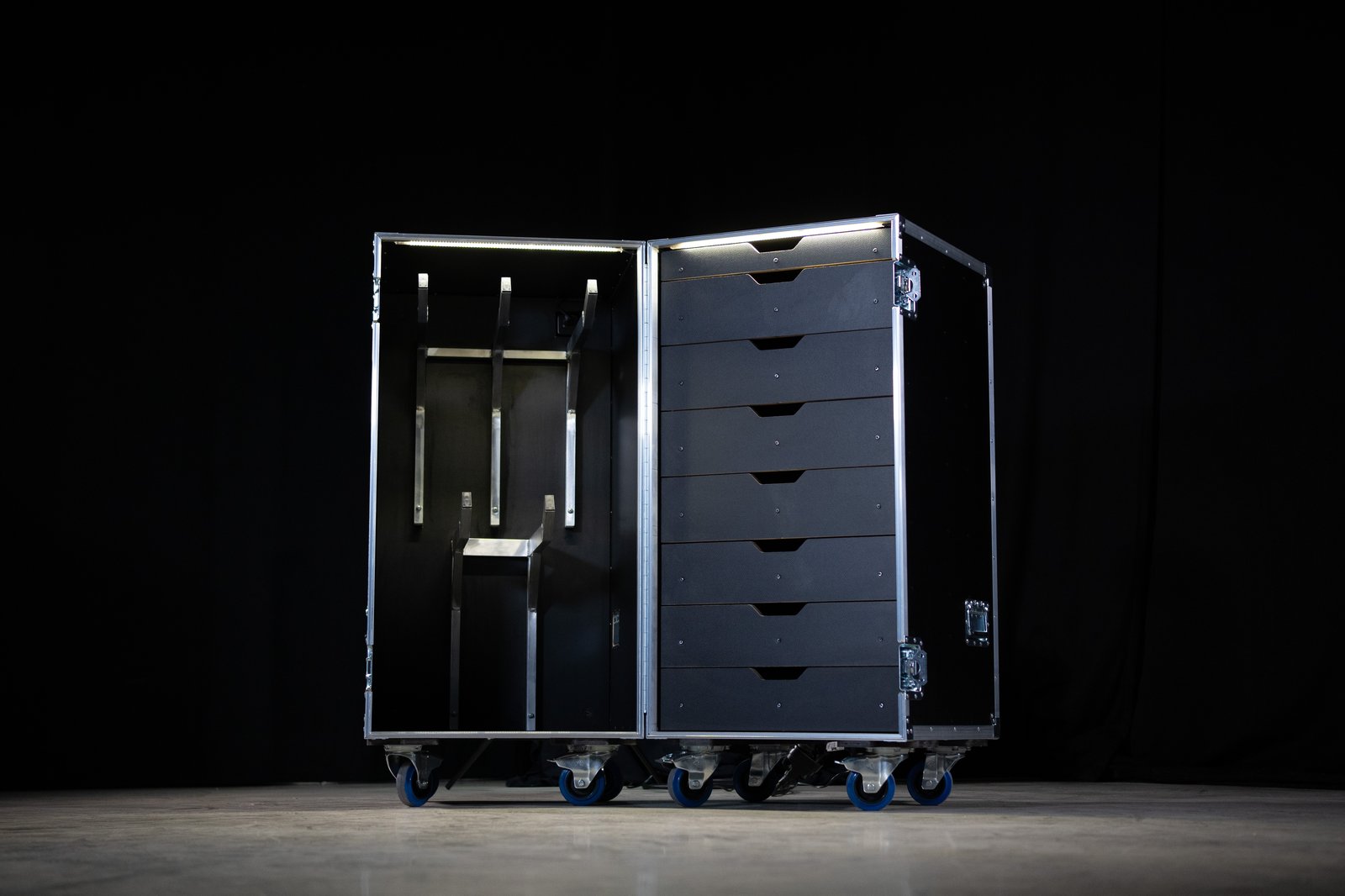
M.Cases integrates bespoke electrical fittings: interior LED strips to illuminate the contents when opened, a built-in power supply with a mains socket on the side panel, power strips or PDUs (power distribution units) to power multiple devices from a single connection. Your flight case becomes a self-contained workstation, ready to use as soon as it is opened.
6. Mounting brackets and boom arms: suspend without improvising
For equipment that needs to be mounted at height — projectors, speakers, screens — the flight case can incorporate mounting brackets or boom arms attached directly to the structure.
The benefit is twofold: the mounting hardware travels inside the case that protects it, and setup requires no extra parts to track down on site. Boom arms can be retractable or removable so they do not take up space in the case during transport.
7. Ventilation: dissipate heat, preserve reliability
A closed flight case is a sealed volume. If the equipment inside generates heat — amplifiers, processors, power supplies — the temperature rises fast. Without ventilation, components overheat, performance degrades and the lifespan of your equipment shortens.
M.Cases offers tailored ventilation solutions: air vents positioned to follow the natural airflow, built-in fans with filters for dusty environments, or discreet vents that ensure passive air circulation. Ventilation is designed from the outset so it does not compromise protection against shocks and dust.
8. Cable pass-throughs: connect without opening
When equipment is used directly inside the flight case, you need to be able to connect it without opening the lid every time. Cable pass-throughs — cut-outs in the panels fitted with brush strips or sealing gaskets — let cables enter and exit cleanly.
This applies to power cables as well as audio, video, network and MIDI connections. Connectors can be panel-mounted on the side of the flight case (XLR, jack, Ethernet, HDMI, IEC, etc.), so that all connections are made from the outside, without handling the equipment inside.
9. Table legs: turn your flight case into a workstation
Some flight cases are designed to serve as a support once on site. A retractable or removable table leg, built into the structure, turns the lid or the case itself into a stable work surface at an ergonomic height.
This option is especially popular for trade show demonstration stations, mobile control desks and outdoor monitoring positions. The leg stows inside the flight case during transport and deploys in seconds on arrival. No need to arrange a separate table: the flight case does it all.
Every project is unique
These options can be combined. A single flight case can incorporate dividers, ventilation, cable pass-throughs and engraving. It all starts with your equipment and your workflow: we study each project to propose the most suitable configuration.