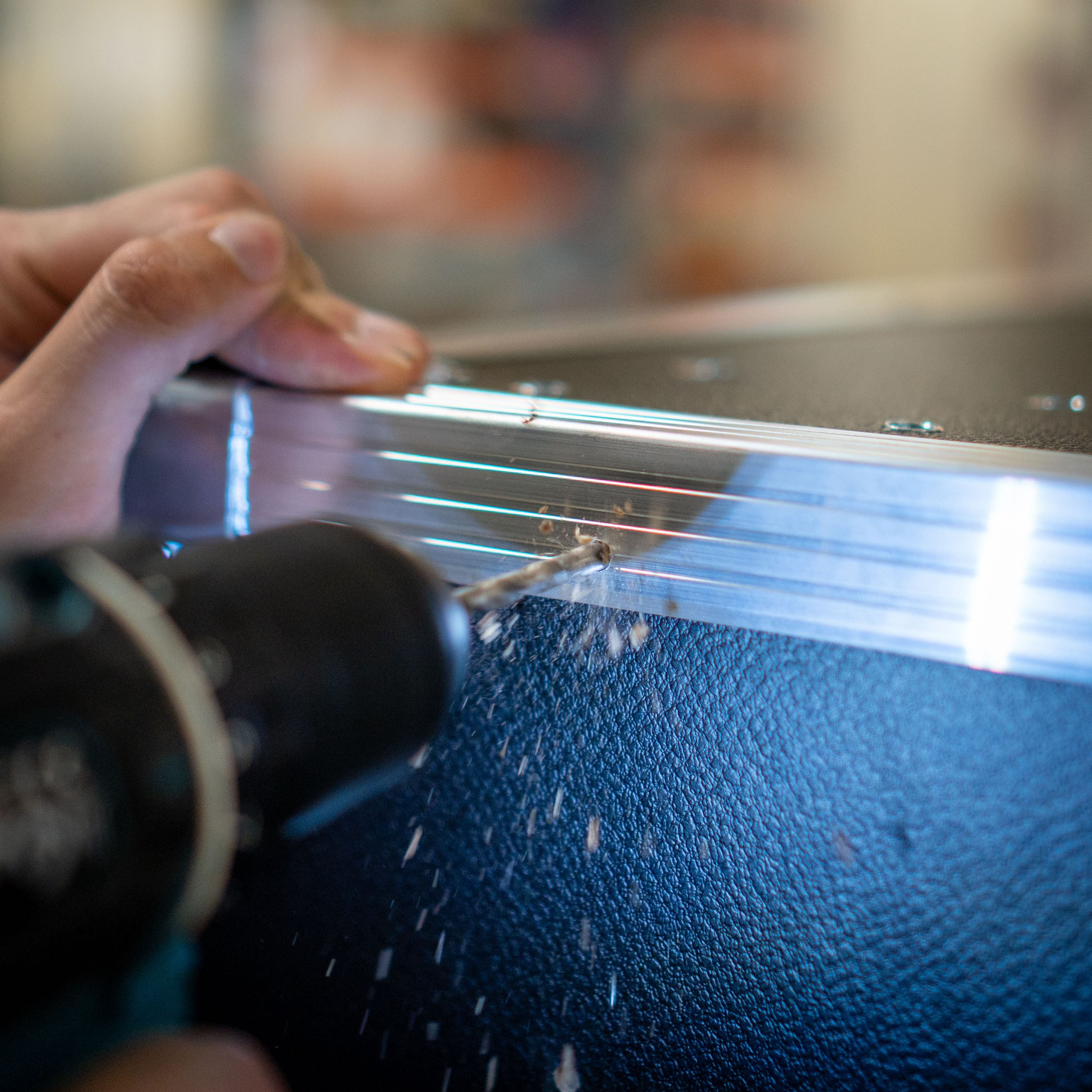
In this guide, we review every component that makes up a flight case, to help you make the right choice for your needs.
1. Start by defining your use case
Before discussing materials, ask yourself four questions:
- What equipment are you transporting? Weight, dimensions, fragility, exposed screens or connectors.
- How often? An 80-date tour does not impose the same constraints as a quarterly trade show trip.
- How is it transported? Truck, aircraft hold, carrier, handling by third parties.
- Do you need to use the equipment without removing it from the case? This applies to audio racks, control desks or "plug and play" flight cases.
The answers will guide each of the choices that follow.
2. The panel: why birch plywood remains the benchmark
The panel forms the walls of the flight case. It absorbs impacts, supports stacking and determines the lifespan of the case. At M.Cases, we made a clear choice: high-quality birch plywood coated with a phenolic film.
A highly resistant multilayer structure
This panel is composed of at least five layers of birch veneer glued with cross-grain orientation. This cross-lamination gives it remarkable rigidity and impact resistance in every direction. The bonding uses phenolic resin, compliant with European standards for structural panels (EN 13986 and EN 314-3).
A phenolic coating that protects the case
Both faces are covered with a 185 g/m² matt black phenolic film:
- the outer face is textured, with a leather-effect finish that hides handling marks and reduces reflections — a real advantage on stage or on set;
- the inner face is smooth, easy to clean and ideal for fitting hardware and interior arrangements.
This film is hard and resists scratches, abrasion, chemicals and UV rays. It also forms a barrier against water, protecting the wood from bad weather and damp floors.
A responsible material
The panel we use holds FSC Mix certification (wood from responsibly managed forests) and complies with formaldehyde emission class E1, as well as the CARB Phase 2 standard.
3. What panel thickness?
We manufacture our flight cases with 9.5 mm panels. This thickness offers the best trade-off between strength and weight:
- it is rigid enough to withstand impacts, stacking and the repeated handling of a tour;
- it guarantees excellent rivet and hardware retention;
- it remains light enough for the case to be manageable on a daily basis.
A panel that is too thin warps and fatigues quickly; a panel that is too thick unnecessarily weighs down every case, and therefore every truck load. The 9.5 mm covers the vast majority of professional needs, from audiovisual to industry.
4. Aluminium profiles
Profiles are the aluminium extrusions that join the panels at the edges. They play a major structural role: they absorb a large part of the impact on corners and edges.
The main types are:
- corner angles, which connect two panels;
- closure profiles (often called male/female or interlocking profiles), which ensure the precise fit between the case and the lid and limit dust ingress;
- hybrid or double-angle profiles, more robust, intended for heavily used cases.
A well-chosen closure profile makes all the difference: a lid that fits perfectly provides better protection and closes more easily, even after years of use.
5. Butterfly latches
The butterfly latch is the emblematic locking system of the flight case. It recesses into the panel so it does not protrude or snag during handling.
Selection criteria:
- size: small, medium or large depending on case dimensions and required clamping pressure;
- quantity: depending on the size, one or two latches may be sufficient.
- lockable or keyed version, if your equipment travels in shared transport or remains stored on site;
- spring and finish quality, which determines the latch's service life.
6. Handles
Often overlooked, handles determine day-to-day handling comfort. Choose spring-loaded recessed handles that fold back automatically and do not protrude from the case. Their placement must take into account the centre of gravity of the contents: a poorly balanced case quickly becomes painful to carry with two people.
7. Castors
Once a flight case exceeds a certain weight, castors become essential. Two questions arise.
Braked or unbraked castors?
Braked castors immobilise the case: essential on a sloping stage, in a truck or when equipment is used directly in its flight case (rack, control desk).
Unbraked castors are simpler and sufficient for short moves on flat ground.
The most common configuration combines both: two braked castors and two free castors, for combined manoeuvrability and stability.
Our recommendation: automatic castors
For fleets of flight cases that are stacked, we recommend automatic castors. They reposition themselves automatically, allowing cases to be stacked on top of each other without having to align each castor by hand. The result:
- faster and safer stacking;
- real time savings during loading and unloading;
- a noticeable improvement in comfort for teams, especially with large fleets of flight cases.
8. Interior fitout: half the protection
A solid shell is not enough if the equipment moves around inside. The interior fitout is just as important as the structure: it absorbs vibrations, prevents impacts between pieces of equipment and makes the case practical on a daily basis.
- Foam: custom-cut to match the shape of each item, it holds equipment firmly and cushions impacts. Its density and thickness are chosen according to the weight and fragility of what it protects. Bonus: you can see at a glance if an item is missing before closing the case.
- Dividers: these internal partitions, fixed or removable, organise the volume of the case and prevent equipment from knocking together.
- Drawers: perfect for storing accessories, small parts or tools, with quick access without unpacking everything.
- Doors: on the front or back, they give access to equipment directly inside the flight case, for racks, control desks or equipment used on-site.
- Cable compartments: a dedicated space prevents cables from tangling or crushing fragile equipment, saving valuable time during setup and teardown.
9. Standard or custom?
It all depends on your equipment and your use case.
The standard flight case is suitable if your equipment matches common formats. It has the advantage of being available quickly. Our standard range includes trunks in the most widely used sizes (60×60, 80×60 and 120×60 cm), 19-inch racks from 2U to 12U and modular compartments for organising the interior. Discover our standard range
The custom flight case is the right choice whenever equipment is expensive, unusually shaped or transported frequently. It eliminates internal movement, optimises volume in the truck and integrates exactly the fittings you need. At M.Cases, every custom project is modelled in 3D before production, and we manufacture from a single unit. Discover custom solutions
Summary: your checklist
- Use case defined: frequency, transport mode, weight and fragility of equipment
- Birch plywood panel with phenolic coating
- 9.5 mm thickness: the right balance of strength and weight
- Aluminium profiles with precise closure
- Sufficient butterfly latches, lockable if needed
- Well-placed recessed handles
- Braked and/or free castors depending on use, automatic if you stack your cases
- Suitable interior fitout: foam, dividers, drawers, doors, cable compartments
- Choice between standard range and custom
Need advice for your project?
At M.Cases, we design and manufacture our flight cases in our workshop near Rennes, in Brittany, France. Every project begins with a study of your equipment and transport constraints, to offer you the most appropriate case: neither undersized nor unnecessarily heavy.